
Showing posts with label weather and climate. Show all posts
Showing posts with label weather and climate. Show all posts
Thursday, August 24, 2017


Saturday, January 28, 2017
Saturday, January 21, 2017
women's marches around the world
https://www.nytimes.com/interactive/2017/01/21/world/womens-march-pictures.html
Mexico

Antarctica

Sydney, Australia

Bangkok

Chicago

London

Nairobi

New York

Oslo

Paris

Vancouver

Washington, DC

Sunday, December 18, 2016
Tuesday, November 8, 2016
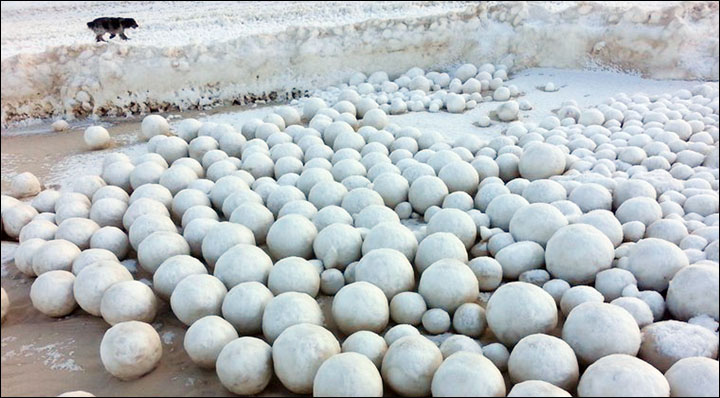
snowballs wash up on beach
There were snowy, icy balls everywhere.
Videos and photos from western Siberia, on the Gulf of Ob, showed an entire beach covered in snowballs that had apparently washed ashore. In one image published online by the Siberian Times, a woman sat on the frozen balls. In another, a dog ran near the balls, which had also formed what looked like a vertical mass of balls mashed together into an icy ball-wall.
The BBC reports that the balls started washing up about two weeks ago. They're strung along some 11 miles of coast and are said to range from about the size of a tennis ball up to almost 3 feet across.
Here's a video of the beach shot by someone named Valery Togo, who told the Russian news site Vesti Yamal that he lives in the nearby town of Nyda, which is on the Yamal Peninsula just above the Arctic Circle.
The BBC reports the chilled orbs that washed ashore "result from a rare environmental process where small pieces of ice form, are rolled by wind and water, and end up as giant snowballs." It adds:
The Collins English Dictionary defines "slob ice" as "sludgy masses of floating ice" in Canadian English.
Rare and original as the ball-forming process might be, this is not the first time humans have witnessed these globular creations. In 2010, a Chicago Tribune video showed snowballs that washed up along Lake Michigan.
npr
Monday, November 7, 2016
Hurricane Matthew Took A Big Bite Out Of Southeastern States' Beaches
Beaches in the Southeastern U.S. took a tremendous beating last month from Hurricane Matthew. The U.S. Geological Survey has found that the storm washed over and damaged 15 percent of sand dunes on Florida's Atlantic Coast, 30 percent along Georgia's coastline and 42 percent of the dunes on South Carolina beaches.
In Florida, few coastal areas were hit harder by the hurricane than the 18 miles of dunes and beaches in Flagler County. County Administrator Craig Coffey says, "What Matthew did to us essentially [was] eat about 30 feet of coastline all the way along the county, and created a bunch of breaches through that dune system."
Matthew also washed out a big chunk of coastal highway A1A in Flagler Beach. The state and county are working to have that road repaired and open within 45 days. Fixing that highway is important, Coffey says. But he is equally worried about damage to the county's beaches and dunes, which provide the community with important protection from tides, wave action and storm surge.
When Hurricane Matthew overtopped and breached Flagler County's beaches, some 800 homes were flooded. Coffey says, "We're trying to figure out how can we protect those for next hurricane season so we don't have more breaches. We literally were fighting breaches in about 10 locations." Flagler County is hoping federal money will be available to help it begin restoring the dunes, which provide protection for hundreds of coastal homes.

Photos taken before Hurricane Matthew (Sept. 6, 2014, above) and after (Oct. 13, 2016, below) show that the storm cut a new inlet between the Atlantic Ocean and the Matanzas River near St. Augustine, Fla., stripping away a 12-foot dune and carrying sand into the estuary.
Many other communities are facing similar problems. The USGS says 53 miles of dunes were damaged and overtopped in Florida. In Georgia, 32 miles of shoreline were affected. Seventy-seven miles of dunes were damaged in South Carolina.
Hilary Stockdon, a research oceanographer at USGS, says a survey of the beaches compared aerial photos taken before and after the storm. It showed extensive beach erosion all along the Southeast Atlantic coast, Stockdon says, "where waves removed sand from beaches and sharply eroded sand dunes. There were locations where houses were undermined or roads were undermined. And we also saw locations where the sand was pushed inland."
After small storms, Stockdon says, beaches and dunes can recover naturally. With major storms like Hurricane Matthew, though, sand is washed inland and bulldozed away, she says. Restoring sand dunes after those events often requires big engineering projects.

Photos taken before Hurricane Matthew (Sept. 6, 2014) and after (Oct. 14, 2016) show that the storm washed away a 16-foot sand dune, destroying boardwalks and decks and exposing a seawall at Vilano Beach, Fla.
Monday, April 4, 2016
Monday, December 7, 2015
keeping politics out of science
About 600 scientists and engineers, including former employees of the National Oceanic and Atmospheric Administration (NOAA), have signed on to letters urging the head of that agency, Kathryn Sullivan, to push back against political interference in science.
For months, Sullivan has been tangling with U.S. Rep. Lamar Smith, a Republican from Texas and chairman of the House Committee on Science, Space and Technology, as he investigates a climate change study done by NOAA scientists.
That study, published earlier this year in the journal Science, cast doubt on what some have called a global warming hiatus — the idea that global warming has slowed in the past two decades.
Smith says his actions are a legitimate part of his oversight duties, but scientists call it harassment.
"Please continue to resist this dangerous abuse of congressional oversight power," the scientists and engineers write to Sullivan in a letter they sent to her Monday. "We urge you to continue to stand firm against these bullying tactics in order to protect NOAA scientists' ability to pursue research and publish data and results regardless of how contentious the issue may be."
In a separate letter, also dated Dec. 7, former NOAA scientists urge Sullivan "to continue to resist any unwarranted congressional investigations that would contribute to stifling the scientific process and even intimidate NOAA scientists and their collaborators."
Jim Buizer, a climate change researcher now at the University of Arizona, used to work at NOAA and says he signed on to this letter after Smith issued a subpoena for, among other things, scientists' emails.
"It hits us on a very personal level, but also on a professional one," Buizer says. "It distracts people from the hard work that they're doing. And it's a distraction that doesn't serve the American people very well."
In the past, he says, people have gotten their hands on emails from climate scientists and taken them out of context to cast doubt on the scientists' research.
"We don't have anything to hide; it's just that people don't understand how we work," says Buizer.
These letters are just the latest in a fierce battle of correspondence that's been waged since the climate change study first appeared in June and came to Smith's attention.
"I have a couple of concerns about this study," the congressman tells NPR. "One, the timing is very suspicious, right before the climate meeting in Paris. Two, we have whistleblowers who have told us it was rushed, just to get it out for the Paris meeting, and some scientists felt like it had not been sufficiently vetted."
Smith says his biggest concern was that the study did not include satellite data, which he calls the gold standard. "It didn't seem to me to be a completely honest study," he says.
Asked if the normal peer review process done at a major journal like Science wouldn't have flagged any missing information or cherry picking of data, Smith says, "I don't think that Science magazine had access to a whistleblower like we did, saying it had been rushed and had not been sufficiently peer-reviewed."
"And, you know," the congressman adds, "Science magazine may have its own bias. I don't know, maybe they wanted to rush it out before the Paris summit as well."
Jesse Smith, a senior editor at Science, tells NPR that the manuscript was submitted in December of 2014, and the review process was thorough and not rushed at all.
"The process actually took longer than it usually does," the Science editor says, "because we subjected the paper to even more scrutiny than we subject most papers to."
What's more, the editor adds, satellite data is irrelevant to this study, which concerns sea surface temperatures from ships and buoys. "The paper wasn't about satellite measurements of tropospheric temperatures," he notes. "It was about sea surface temperature measurements, which are just one part of a larger picture."
"The scientific process is modern civilization's best means for arriving at reliable truth," says Rush Holt, the executive publisher of Science and head of the American Association for the Advancement of Science. "And that process should be allowed to work without political meddling," he says. The AAAS is one of eight major scientific associations that recently wrote to the congressman to express concern about the "chilling effect" this inquest could have on science.
Holt, a physicist who spent more than a decade in the U.S. House of Representatives as a Democrat from New Jersey, seems especially peeved that Smith issued the subpoena.
"You don't issue subpoenas to scientists for doing their conscientious work," says Holt. "It's certainly an abuse of subpoenas."
Others agree that a congressional subpoena is a big hammer. "People normally think about that related to wrongdoing, to misconduct, to a criminal act, or to corruption," says Andrew Rosenberg, a former NOAA fisheries scientist now at the Union of Concerned Scientists. "I think what he's doing is bullying. I think it's intimidation tactics."
Rosenberg notes that a rule change earlier this year means the chairman of the House science committee can now issue subpoenas more easily, without having to confer with the ranking minority member of the committee.
Currently that's Rep. Eddie Bernice Johnson, D-Texas, who tells NPR that what Lamar Smith is doing "appears to be about politics. I haven't seen much science in it."
In an October letter to the Texas congressman, Johnson notes that "in the past two years and ten months that you have presided as Chairman of the Committee on Science, Space, and Technology, you have issued more subpoenas (six) than were issued in the prior 54-year history of the Committee."
When asked about the accusation that he has used his power as chairman to harass scientists whose work he does not like, Smith says he has a responsibility to conduct oversight.
"And when I see government agencies using taxpayers' dollars and not coming up with studies that I think are based upon good data and good evidence and good science," Smith tells NPR, "then I think not only do the people have a right to know that, their representatives in Congress have a right to know that as well."
"In this case, I just simply want the facts to come out," Smith says. "And for reasons I don't understand, NOAA is resisting giving us the information that we requested, which of course would naturally make people suspicious."
NOAA spokesperson Ciaran Clayton says Smith's complaint that NOAA is resisting his requests for information is just not so. "We feel we've provided all the information that the committee needs to understand the issue," says Clayton.
The scientists who did the study briefed committee staffers two times to answer questions about the study's rationale and methodology, Clayton notes. Plus, she says, all of the data is publicly available on the agency's website.
NOAA has a scientific integrity process that allows employees to make anonymous complaints if they feel there's been an abuse of science or scientific misconduct. Clayton says no one has complained about this climate change study.
Right now, NOAA is working to respond to the latest letter from Lamar Smith. Although his previous requests included documents and communications to and from NOAA scientists, Smith has now prioritized getting emails and other documents relating to the study from nonscientist NOAA staffers. He's asked to see the information no later than Dec.15. npr
Thursday, October 1, 2015


Monday, September 28, 2015
Scientists Confirm There's Water In The Dark Streaks On Mars

For several years, a satellite orbiting Mars has seen streaks flowing from Martian mountains during warm periods on the surface. Scientists have now confirmed that water is involved.
Scientists have caught Mars crying salty tears.
Photos from NASA's Mars Reconnaissance Orbiter show dark streaks flowing down Martian slopes. The streaks appear in sunny spots or when the weather is warm, and they fade when the temperature drops.
Water was suspected to be involved, but now scientists have confirmed its presence. The new analysis, published in Nature Geoscience, shows salts mixed with water when the streaks are darkest. The water disappears when the streaks lighten.

Streaks a few hundred feet in length appear on the walls of Garni crater on Mars. Scientists suspect they are formed by the flow of briny, liquid water on Mars.
"It's only when these streaks are biggest and widest that we see evidence for molecular water," says Lujendra Ojha, a graduate student at the Georgia Institute of Technology.
Ojha cautions this isn't the same as streams trickling downhill on Earth. Standing on the streaks would be like standing on a hot beach on Earth and dribbling a little water out of a drinking bottle. "You would just see a hint of wetness," he says.

The lines appear on slopes with exposure to sunlight. Researchers now believe that the warm sun may cause water to begin flowing.
Ojha says the water could be important for future exploration of Mars. It might be that astronauts could one day use it for everything from drinking water to rocket fuel, but that depends on how much there is.
The water could be coming from a subsurface reservoir, but that's not the only option, Ojha says. Ice, or even moisture in the atmosphere, could also be causing the streaks.
"We're not entirely sure what the source of the water may be," he says. npr
More images available at nytimes.com/interactive/2015/09/28/science/space/mars-nasa-flowing-water.html
More images available at nytimes.com/interactive/2015/09/28/science/space/mars-nasa-flowing-water.html
Tuesday, September 1, 2015
Gasping for air: nutrients, warming trigger ocean oxygen deficit
“When you can’t breathe, nothing else matters,” once a tagline of the American Lung Association, today it might easily describe what is happening in many areas of the ocean. Hypoxia, the lack of oxygen in our estuaries, coastal and deep ocean waters, is on the rise and endangering marine life around the world. Its causes are a complex mix of excess nutrients and our warming world. Agriculture, human waste, and rising levels of atmospheric CO2 underlie these changes.
Denise Breitburg, senior scientist at the Smithsonian Environmental Research Center in Edgewater, Md. near the Chesapeake Bay, answers a few questions about marine hypoxia.
Breitburg and Lisa Levin of the Scripps Institute of Oceanography were co-authors of a recent article on ocean deoxygenation in the journal Nature Climate Change.
Q: Where does hypoxia occur in the ocean?
Breitburg: It occurs in estuaries, along our coasts and in the deep ocean.
In estuaries, the areas where fresh and salt water meet, and in some coastal waters, hypoxia is caused by overstimulation of algal growth by nutrients from human activities, primarily agriculture and human waste. Some nutrients are OK but large amounts result in too much algae. Algae that aren’t consumed by animals die and decompose in great quantities. Decomposition depletes the oxygen in the water causing low-oxygen zones. Basically, many microbes use oxygen and release carbon dioxide when they respire, just like people do when they breathe.

A truck applies nutrient rich liquid manure to a farm field, some of which will end up in streams, estuaries and the ocean. (Photo courtesy Chesapeake Bay Program)
In the deep ocean, deoxygenation is mainly a natural phenomenon. Oxygen is mixed into the water at the surface but once you reach a certain depth you no longer get much benefit from that mixing. In addition, organic matter produced near the ocean surface can wind up sinking to bottom waters. Microbial decomposition of this organic matter depletes the deep oxygen and creates large deoxygenated zones.
Coastal and open-ocean hypoxia have long been regarded by scientists as distinct, but our world is highly interconnected. For example, there is some evidence that nutrient enrichment from human activities, a known cause of coastal hypoxia, could also increase deeper water low oxygen zones. Some systems, such as the Gulf of St. Lawrence, experience hypoxia that appears to be caused both by nutrients coming from land and the inflow of deep oceanic water that is naturally low in oxygen.

Oxygen is mixed into the ocean at the surface, but beyond a certain depth there is no benefit from this surface mixing. (Flickr photo by David Robertson)
Q: Do deep water hypoxic zones stay down deep?
Breitburg: No. Deep areas of low oxygen water become a problem when they upwell near shore, bringing their very low oxygen waters right up to the shallows. The upwelling also brings nutrients to the surface, which is one reason we have incredibly productive fisheries along the west coasts of many continents including North America, South America and Africa.
Upwelling of deep ocean water is caused when a combination of persistent longshore winds and the earth’s rotation push coastal surface water out to sea. In response, deep water moves up to bathe the continental shelves in hypoxic water that is also more acidic than open ocean surface water. Warming atmospheric temperatures very definitely affect wind patterns that cause this upwelling.
Continental margins, shelves and estuaries around the world that were previously well oxygenated, now experience hypoxia either seasonally or episodically. For example, upwelling is creating seasonal dead zones on the inner Oregon Shelf.

A phytoplankton bloom is visible off the coast of Argentina, just south of the Rio de la Plata estuary (visible in the top of the image). (Photo Credit: Jeff Schmaltz, MODIS Land Rapid Response Team at NASA GSFC | NASA Earth Observatory)
Q: What happens to marine animals during these events?
Breitburg. Animals like bivalves, worms or corals that can’t easily swim away from areas of low oxygen are especially vulnerable, but even fish that are strong swimmers can be trapped and killed. Low oxygen levels in oceanic and estuarine waters can alter food webs, growth rates, and make organisms more susceptible to disease. If a low-oxygen event is severe or long-lasting, it can have a devastating impact on a region. This can translate into a loss of the ocean resources humans depend on.
Q: Would removing nutrients from estuaries help?
Breitburg: It’s not a matter of trying to get nutrients out of the estuaries or the ocean. It’s a matter of trying to reduce what we are putting in. If we turn the spigot off, these systems will, over time, clean themselves up. In some cases it would be very quick, maybe a few years, not necessarily hundreds or thousands.
There are a lot of efforts worldwide to reduce nutrients going into estuaries and other coastal waters. Some of them have been very successful. Some are making slow incremental progress. Overloading a system with nutrients is a problem that is much better to prevent than to try to correct.

Algae blooms are often referred to as red tides because of their red color in the water. Red tides, like this one in La Jolla, Calif., can form as a result of nutrient pollution. (Flickr photo by Alejandro Díaz)
Friday, July 17, 2015
How Air Pollution May Have Caused Catastrophic Flooding In China
Air pollution isn't just bad for your health. It can have dramatic effects on weather and climate. In fact, a team of scientists believes that air pollution from industries and traffic could have caused the extreme floods that devastated southwest China in 2013.
In July of that year, China's Sichuan province was racked with floods from the worst storms it had seen in 50 years. The greatest damage occurred in a mountainous region northwest of the Sichuan Basin, where nearly 30 inches of rain fell over several days. A combination of flooding and a landslide triggered by the rain left over 50 people dead, more than 100 missing and thousands without homes.

Watching news coverage of the flooding, atmospheric scientist Jiwen Fan noticed a pattern: The mountains with the worst flooding were downwind of the Sichuan Basin, a valley with air that's highly polluted from factories and cars. Surrounding mountains rise steeply from the valley floor, trapping polluted air over the basin. She suspected that the lingering cap of soot had something to do with the heavy rainfall that fell in the mountains, but not the valley.
Where did this soot come from? Soot is a type of pollutant called black carbon, which is produced by burning biomass or fossil fuels. When these fuels are burned, the process can release byproducts like carbon monoxide and very fine particles of black carbon. The black carbon particles are suspended in the atmosphere as an aerosol, which we call soot. Black carbon as soot affects climate and temperature by absorbing the sun's radiation before it gets to the earth. According to the Environmental Protection Agency, this can mean increasing temperatures, faster melting of snow and ice, and changes in clouds.
And, as Fan knew, soot can affect weather systems.
Fan, who researches at the Pacific Northwest National Laboratory, gathered a team of scientists to figure out the cause of the extreme weather. Their results were published in June in Geophysical Research Letters. The scientists built computer models of the weather in the Sichuan Basin, both with the current amount of air pollution, caused by decades of industrialization, and with clean air as it had been 40 years previously. In both models, they ran simulations of the weather on the day before and the days of the storm.
When they compared the two models, they saw a dramatic difference.
Without pollution, Fan says, the basin would have experienced mild rain during the day before the storm hit. Moist air would have moved in from the Indian Ocean over the land, risen and formed a cloud. Moisture condenses inside clouds to form droplets of water, which, when they get heavy enough, fall to the ground as rain. In this scenario, by the time that air rose over the mountains, it would have already lost a lot of its moisture, and extremely heavy rains wouldn't form.
Instead, she says, the soot prevented rain from forming over the basin. The pollution particles absorbed heat from the sun, warming the air higher up while blocking that warmth from getting to the surface. The moist air at ground level couldn't rise and form storms. It was stuck beneath the soot during the day, where it gathered moisture and energy, traveling downwind and reaching the mountains at night. As it rose, following the contours of the land below, it finally formed into clouds and released all that pent-up power. The result: massive storms that flooded the region.
"So basically," Fan says, "the pollution transformed this mild rain over a very large area of the basin during the daytime into a heavy rain, focused on a narrow area over the mountains." According to the team's calculations, the presence of air pollution made it rain up to 60 percent harder over the mountains than it would have without the pollution effect. So more rain fell in less time.
"We were surprised at the scale of the pollution effect," Fan says. The scientists suggest that in areas with similar geography, pollution might exacerbate weather in similar ways, leading to more extreme weather events.
Geeta Persad, a Ph.D. student in Princeton University's Atmospheric and Oceanic Sciences program, thinks this study is compelling. "It does a neat job of giving a concrete example of how air pollution in these systems can have detectable effects," she says. And in Persad's opinion, studies that link mechanisms with real-world events — such as air pollution causing flooding — are more useful to people making policy decisions than more general studies.
But, she says, it's important not to generalize too much. "The conditions they're pointing out may not be universal," Persad says. The soot layer in other regions, for instance, might be at a different height — either above or below the rain cloud. Also, other locations might not get the same kind of moist air inflow, or might have different topography or be polluted with a different aerosol.
Fan is aware of these limitations. Right now, she says, her team is working to understand the weather effects of different types of aerosol pollutants in several locations. In the meantime, she thinks weather reports should take into consideration the aerosols in the atmosphere. Since air pollution particles have a short life span, cutting down on pollution could have immediate effects in preventing severe weather events. npr
Science Confirms 2014 Was Hottest Yet Recorded, On Land And Sea
For the past quarter-century, the National Oceanic and Atmospheric Administration has been gathering data from more than 400 scientists around the world on climate trends.
The report on 2014 from these international researchers? On average, it was the hottest year ever — in the ocean, as well as on land.
Deke Arndt is a climate scientist with the agency and an author of the State of the Climate in 2014 report, released Thursday. It's the lower atmosphere that's warming, not the upper atmosphere, he points out — just as the total of greenhouse gases in the lower atmosphere continues to increase. That's not a coincidence.
"The changes that we see in the lower part of the atmosphere are driven by a change in the composition of the atmosphere," Arndt says. "If an external forcing — such as the sun or some orbital phenomenon — would be driving the warming, we would see a warming across the board in most of the atmosphere. And we don't."
This year's hottest-ever record is the third time that's happened in the past 15 years.
The annual spike in ocean temperature — specifically, in the upper 2,000 feet of water in most of the world's oceans — was especially big last year, the scientists say.
"You can sort of think of ocean warming as being global warming, since that's where most of the global warming goes," says Greg Johnson, an ocean scientist at NOAA.
A lot of extra heat has been trapped in the lower atmosphere over the past several decades, Johnson says. And the ocean is going to continue to suck up that heat and get warmer.
Moreover, the oceans expand when they get warmer. That raises sea levels, which — again, no coincidence — reached their highest point last year, as well.

Floodwaters from rising sea levels have submerged and killed trees in Bedono village in Demak, Central Java, Indonesia. As oceans warm, they expand and erode the shore. Residents of Java's coastal villages have been hit hard by rising sea levels in recent years.
Glaciers continued to melt. And the extent of Arctic sea ice kept shrinking as well.
On the temperature front, Europe was hotter than ever. But it wasn't hotter than blazes everywhere. The eastern U.S. got a break. The winter there was especially cold, which led some climate skeptics to question the whole idea of climate change.
Jessica Blunden, a climate scientist and report author who consults for NOAA, says the weather in the East was an outlier.
"For example, the lower latitudes of eastern North America and parts of Russia were well below average during this period — up to 10 degrees Fahrenheit below average," Blunden says. "But then in the higher latitudes, Alaska, for example, was super warm for this time of year — 18 degrees above average in late January.
So the eastern U.S. got lucky — if you consider record-breaking snow, and cold weather lucky. Keith Seitter, head of the American Meteorological Society, which published the report, found that ironic.
"I'm here in Boston," he says. "We had an incredibly tough winter, but that doesn't change the fact that the globe is getting warmer. And 2014 really represents some kind of landmark year in that respect."
As the climate report shows, weather is local. Climate is global. npr
Subscribe to:
Posts (Atom)