Showing posts with label global. Show all posts

Wednesday, June 6, 2018

17 Pounds Of Plastic Kills Whale, Highlighting Ocean Pollution


Some 80 plastic bags extracted from within a whale are being laid out in Songkhla, Thailand, in this still image captured from video footage.
Thailand's Department of Marine and Coastal Resources/Social Media/via REUTERS ATTENTION EDITORS

Around 80 sopping wet, black plastic bags lined the floor of an operating room in Thailand last week after they were pulled from the stomach of a whale found stranded on a beach.
The pilot whale, which washed ashore in the southern province of Songkhla, later died after veterinarians tried for five days to save its life, according to the country's Department of Marine and Coastal Resources. An autopsy found nearly 17 pounds of plastic inside the whale's belly, a marine official told Reuters.
The whale's death and photos released by the department serve as a reminder of a growing global problem: plastic debris flowing into the ocean and killing wildlife.
"We are creating the horrible dystopian future that nobody wanted," Enric Sala, an explorer-in-residence and marine ecologist with National Geographic, tells Here & Now's Robin Young.

Monday, April 3, 2017

How America's Idea Of Illegal Immigration Doesn't Always Match Reality


more info on the statistics on npr

The best and worst places to be a working woman

The Economist has published its fifth annual “glass-ceiling index”. It combines data on higher education, workforce participation, pay, child-care costs, maternity and paternity rights, business-school applications and representation in senior jobs into a single measure of where women have the best—and worst—chances of equal treatment in the workplace. Each country’s score is a weighted average of its performance on ten indicators. 

The overall picture painted by the data is that the long trend of improving conditions for working women has flatlined within the OECD, a club of mostly rich countries. In 2005, 60% of women were in the labour force; ten years later, this ratio had edged up only slightly to 63% (it was 80% for men in both years). With relatively few women climbing the ranks, and strong old-boys’ networks helping men reach the top, female representation in well-paid and high-status jobs is closer to a third than half. And the gender wage gap—male minus female wages, divided by male wages—is still around 15%, meaning women as a group earn 85% of what men do.

These broad averages conceal wide variation between countries. The Nordic countries clearly lead the world on gender equality at work. The top four positions this year belong to Iceland, Sweden, Norway and Finland, just as they did in 2016 (though Sweden and Norway did switch places). Women in these countries are more likely than men to have a university degree and be in the labour force. They make up 30-44% of company boards, compared with an average of 20% across the OECD. And voluntary political-party gender quotas mean that women are well-represented in parliaments. In October, women won a record 48% of the seats in Iceland’s lower house. At around two-fifths, Scandinavian women’s share of parliamentary seats ranks in the top 10% globally.

Latest updates

See all updates
At the other end of the index are Japan, Turkey and South Korea. Women make up only around 15% of parliaments in these countries, and are underrepresented in management positions and on company boards. In South Korea, just 2% of corporate directors are female. Similarly, fewer women than men have completed tertiary education and are part of the labour force. Only 35% of Turkish women are working or looking for work, and a mere 16% have graduated from university.

Progress in gender equality has a tendency to build upon itself. In Iceland, which currently provides the most equal working environment for women according to our index, female workers staged a protest last October in which they marched out of their offices early to call attention to the country′s 14% gender pay gap. If Japanese women were to do likewise, they would be leaving much earlier.


Saturday, January 21, 2017

women's marches around the world

https://www.nytimes.com/interactive/2017/01/21/world/womens-march-pictures.html

Mexico

Antarctica

 Sydney, Australia

Bangkok

Chicago

London

Nairobi

New York

Oslo

 Paris

Vancouver

Washington, DC

Tuesday, November 8, 2016

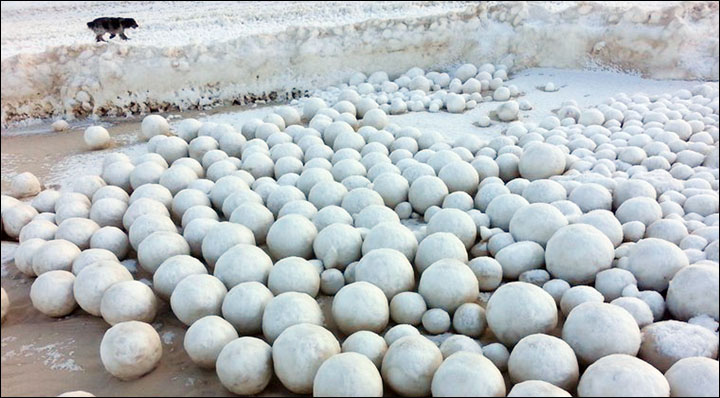
snowballs wash up on beach

There were snowy, icy balls everywhere.
Videos and photos from western Siberia, on the Gulf of Ob, showed an entire beach covered in snowballs that had apparently washed ashore. In one image published online by the Siberian Times, a woman sat on the frozen balls. In another, a dog ran near the balls, which had also formed what looked like a vertical mass of balls mashed together into an icy ball-wall.
The BBC reports that the balls started washing up about two weeks ago. They're strung along some 11 miles of coast and are said to range from about the size of a tennis ball up to almost 3 feet across.
Here's a video of the beach shot by someone named Valery Togo, who told the Russian news site Vesti Yamal that he lives in the nearby town of Nyda, which is on the Yamal Peninsula just above the Arctic Circle.


The BBC reports the chilled orbs that washed ashore "result from a rare environmental process where small pieces of ice form, are rolled by wind and water, and end up as giant snowballs." It adds:
"Russian TV quoted an explanation from Sergei Lisenkov, press secretary of the Arctic and Antarctic Research Institute:
" 'As a rule, first there is a primary natural phenomenon — sludge ice, slob ice. Then comes a combination of the effects of the wind, the lay of the coastline, and the temperature and wind conditions.'
" 'It can be such an original combination that it results in the formation of balls like these.' "
The Collins English Dictionary defines "slob ice" as "sludgy masses of floating ice" in Canadian English.
Rare and original as the ball-forming process might be, this is not the first time humans have witnessed these globular creations. In 2010, a Chicago Tribune video showed snowballs that washed up along Lake Michigan.

npr

Saturday, September 10, 2016

Filipino Fisherman Reveals 75-Pound Pearl He Kept Hidden For A Decade

A fisherman in the Philippines might have discovered the largest natural pearl ever found — and then kept it hidden under his bed for 10 years.
The pearl's existence was revealed by Aileen Cynthia Maggay-Amurao, a tourism officer in Puerto Princesa, on the island of Palawan.
She says the fisherman is one of her relatives and that he discovered it in a giant clam and kept it as a good-luck charm.
When he was moving out of his home, he decided to give the pearl to Maggay-Amurao for safekeeping instead of transporting it with him — "since it's quite heavy," she told The Guardian.
In fact, the pearl weighs in at 34 kilograms, Maggay-Amurao says — or approximately 75 pounds.
It's more than 2 feet long and 1 foot wide, CNN reports.
That would make it far and away the largest natural pearl ever found in a giant clam. The current world record is held by another pearl found off the coast of Palawan — "The Pearl of Allah" or "Pearl of Lao Tzu," which was discovered in the '30s and cost a diver's life to retrieve.
That pearl, which the Guardian says was valued at $93 million in 2003, weighs 14 pounds — a fraction of the size of the newly revealed pearl.
The 75-pound pearl is now on display in the city hall of Puerto Princesa; the local government has dubbed it the "Pearl of Puerto."
Maggay-Amurao, who says she persuaded her relative to display the pearl instead of hiding it, has called for gemologists to visit Puerto Princesa to examine the pearl for authenticity and an estimate of its value.
A spokesman for the Puerto Princesa government says the fisherman who found the pearl hasn't signed it over to the city, Agence France-Presse reports. "It remains his property," the spokesman says, confirming that the man could be in for an extraordinary windfall.
For the record, a 75-pound pearl would be 170,000 carats. npr

Sunday, July 17, 2016

U.N.'s Project Everyone- Tell me What you Want


The U.N.'s Project Everyone — a group founded by filmmaker Richard "Love Actually" Curtis — has put out a video with the original recording but a new girl power emphasis. In the video, British girl group M.O, Canadian YouTube star Taylor Hatala, Nigerian-British singer Seyi Shay and Bollywood actress Jacqueline Fernandez lip sync and dance to the song against backdrops with signs calling for "equal pay" and an end to violence against women.

The video is part of the Global Goals campaign, a U.N. initiative to promote the Sustainable Development Goals for 2030. npr

Thursday, May 19, 2016

4 Things To Know About Hillary Clinton's Approach To Foreign Policy

As a former senator and secretary of state, Hillary Clinton has a long foreign policy track record. That record suggests she'd be more hawkish than President Obama — and many of her fellow Democrats. But don't expect her to go overboard. She knows all too well the political price that can come with military intervention.
Here are four things to know about Clinton's approach to foreign policy:
(We've previously broken down Donald Trump's and Bernie Sanders'approaches to foreign policy.)
1. She's experienced
2. She's more hawkish than President Obama
3. She might not be that hawkish
4. She's concerned about alliances

1. She's experienced
If Clinton is elected, she'll have more foreign policy experience than any president since George H.W. Bush. She traveled extensively as first lady and as a senator and logged nearly a million miles visiting 112 countries as secretary of state. "Hillary Clinton is really the rare candidate with a long track record," said Elizabeth Saunders, a visiting fellow at the Council on Foreign Relations.
The former secretary will try to make that background an asset in the campaign, arguing the country can ill afford a president who needs on-the-job training. "Our new commander in chief will walk into the Oval Office and find a world of hard choices and tough problems," Clinton told an audience at Stanford this spring. "So the stakes could not be higher."
2. She's more hawkish than President Obama
Clinton is less reticent when it comes to deploying military force than President Obama. While she hasn't advocated large-scale ground operations, she has pushed for the creation of "safe zones" in Syria, and she was a strong advocate for the U.S. military intervention in Libya. "Her default preference seems to be for action," Saunders said. "People have described her as having a preference for being 'caught trying.' She'd rather do something and be criticized for it than be criticized for doing nothing at all." That distinguishes Clinton's foreign policy approach from Obama's, whose instinctive caution has been summed up by the phrase, "Don't Do Stupid [Stuff]."
3. She might not be that hawkish
If Obama's caution is, in part, a reaction to the excesses of the George W. Bush era, Clinton's more aggressive posture might reflect a reversion to the mean. But don't expect her to go overboard. After all, she paid a political price for backing Bush's invasion of Iraq in 2003, as well as the Libyan intervention in 2011, which left a violent vacuum in which four Americans were later killed in Benghazi.
"Given the fact that many of her decisions to use military force have come back to haunt the United States generally and Hillary Clinton specifically, she may well have to temper some of those hawkish instincts in the service of prudence. And the reality is that we have very bad options," said veteran Middle East diplomat Aaron David Miller of the Woodrow Wilson Center. Clinton has criticized some of the more hawkish proposals from Republican candidates for indiscriminate bombing of ISIS. "Proposing that doesn't make you sound tough. It makes you sound like you're in over your head," Clinton said at Stanford. "Slogans aren't a strategy. Loose cannons tend to misfire. What America needs is strong, smart, steady leadership to wage and win this struggle."
4. She's concerned about alliances

Compared to her remaining presidential rivals Donald Trump and Bernie Sanders, Clinton is a committed internationalist. "For decades, Republican and Democratic administrations have understood that America's alliances make us stronger," Clinton told the Stanford audience in March. "Turning our back on our alliances or turning our alliance into a protection racket would reverse decades of bipartisan American leadership and send a dangerous signal to friend and foe alike."
Erstwhile Republican White House hopeful Carly Fiorina complained that all of Clinton's globetrotting as secretary of state produced little in the way of concrete agreements. But the Council on Foreign Relations' Saunders says that's too simplistic. "Diplomacy is important but it's not always dramatic," Saunders said. "Most high-level diplomatic travel by the president or secretary of state is really about tending to relationships." npr

Friday, March 11, 2016

America's High School Graduates Look Like Other Countries' High School Dropouts

A new study confirms what many Americans already knew deep in their hearts: We're not good at math.
Not only that, but when it comes to technology skills, we're dead last compared with other developed countries.
The PIAAC study — the Program for International Assessment of Adult Competencies — looks at the skills adults need to do everyday tasks, whether it's at work or in their social lives.
"Clearly, we have some work to do in this country," says Peggy Carr, the acting commissioner of the government's National Center for Education Statistics. The study compared countries in the Organization for Economic Co-operation and Development (OECD).
Japan and Finland led the group in literacy, math and technology skills, while the United States' performance was average or well below average in each category.
Literacy
Overall, Americans' everyday literacy skills were average. But if you zoom in and focus on just the young adults, a more complex picture emerges.
Americans who went to college and graduate school did well. They scored above their peers with similar degrees in other developed countries.
For young adults with a high school diploma or less, things did not look so good. These Americans performed significantly worse than those in other countries with the same education level.
"Postsecondary institutions should be happy," says Carr. "But on the other end of the continuum, we have young people coming out of high school — or not graduating from high school — that are struggling with everyday competencies."
Math
Carr says this pattern is even more obvious if you look at the math skills of young adults. This study found that Americans with a high school diploma performed about the same as high school dropouts in other countries.
"We need to think seriously about how to get them functioning better," says Carr.
She offers a sample math problem from the test: You go to the store and there's a sale. Buy one, get the second half off. So if you buy two, how much do you pay?
"High school-credentialed adults, they can't do this task — on average," says Carr.
Technology
When it comes to technology skills, the story gets worse. The U.S. came in last place — right below Poland.
The study looked at basic technology tasks: things like using email, buying and returning items online, using a drop-down menu, naming a file on a computer or sending a text message.
Across the board, Americans performed poorly on these tasks. However, there was a significant racial difference, with nonwhites scoring below whites.
"I don't think we were particularly shocked by that finding," says Carr. She points out that these racial differences are similar to what other national and international studies have found.
She says these findings should be concerning to everyone, especially leaders in the business community and in the K-12 school systems. npr

Shadow Of The Moon Crosses Earth During Solar Eclipse

Thursday, December 24, 2015

Fact Check: Did Obama Withdraw From Iraq Too Soon, Allowing ISIS To Grow?

Like everyone else, the Republican candidates talk about ISIS a lot. And what they — at least Ben Carson, Carly Fiorina and former Florida Gov. Jeb Bush — charge is that ISIS is President Obama's fault, because he withdrew troops from Iraq in 2011 — when he should have kept them there to keep a lid on the insurgency.
Let's Break It Down:
The Claim:
"Barack Obama became president, and he abandoned Iraq. He left, and when he left al Qaida was done for. ISIS was created because of the void that we left, and that void now exists as a caliphate the size of Indiana." — former Florida Gov. Jeb Bush
The Big Question:
OK, maybe it's actually two questions:

  1. Is Obama responsible for the timing of the troop withdrawal from Iraq?
  1. Did that withdrawal cause the rise of ISIS?

And there are answers for both, though not simple ones.
The Long Answer:
First, we have to decide on a starting point.
Many Democrats, and even a few Republicans, say we should look back to the 2003 U.S.-led invasion of Iraq. That, and the dismantling of the entire security force, created an angry, mainly Sunni demographic, which fueled the insurgency that would later become ISIS.
Others go back further, pointing out the strong links between Saddam Hussein's brutal Baathist regime, and the structure, methods and, indeed, commanders of ISIS.
But if we take the invasion as a given, and Saddam Hussein as history, we can begin the answer to the first question —
Was Obama responsible for the timing of the withdrawal?
It was President George W. Bush who signed the Status of Forces agreement in 2008, which planned for all American troops to be out of Iraq by the end of 2011.
"The agreement lays out a framework for the withdrawal of American forces in Iraq — a withdrawal that is possible because of the success of the surge," he said in a joint press conference with Iraqi Prime Minister Nouri al Maliki at the time.
Moments later, an Iraqi journalist threw his shoes at the president. It is important to remember most Iraqis saw the Americans as occupiers and blame them for civilian deaths.
Maliki summed up the sentiment at the time, thus:
"The incomplete sovereignty and the presence of foreign troops are the most dangerous, most complicated and most burdensome legacy we have faced since the time of dictatorship. Iraq should get rid of them to protect its young democratic experiment."
Thousands of American troops had died, and by the time Obama announced the withdrawal, fully three-quarters of Americans supported the withdrawal (though a majority of Republicans did not).
Still, many had real concerns al Qaeda wasn't done for. And there were some, including U.S. senators, saying the troops should stay just in case things went downhill. They say Obama should have sold the idea, hard, to Maliki.
Iraq analyst Kirk Sowell said Obama never really tried.
"This is one of the criticisms of Obama — that he sort of wanted the negotiations to fail," Sowell said, "and, so, he didn't even talk to Maliki until it was basically all over."
The State Department's lawyers said troops couldn't stay in Iraq unless the Iraqi parliament authorized them to do so, including granting them immunity from Iraqi law. The Iraqi parliamentarians would never OK such a decision, with Iraqi popular opinion staunchly against U.S. troops staying.
Sowell saw State's decision as a deliberately insurmountable obstacle.
"It was a barrier that was very high," he said, "and there was no way it was going to be jumped over."
But, does Obama bear responsibility for the timing of the troop withdrawal? On balance, no.
He was following through on an agreement made by Bush and abiding by the will of the Iraqi and American people.
Alright so, onto the next question —
Did the withdrawal of troops lead to the rise of ISIS?
Back then, in 2011, there was no ISIS. The group didn't exist under that name yet. There was just their predecessor, al Qaeda in Iraq, which had been at the forefront of the terrible insurgency in Iraq. But many thought it was licked.
"All of the intelligence that we had gathered, all of the results of the surge, all of the detainees we had in our detention system, all of the information we had coming to us from people on the ground, from the tribes indicated that al Qaeda in Iraq was defeated," said Ret. Col. Peter Mansoor, who served in Iraq.
That surge was the influx of American soldiers, and the way the U.S. military organized Sunni tribes to fight against insurgents. The Americans paid them, helped arm them and gave them air cover.
One of those tribal leaders, Sheikh Hamid Taees, told me: "In May of 2006, I worked closely with the American side to rid Anbar of terrorism and al Qaeda, and actually we killed a large number of al Qaeda fighters."
But by the time of that comment, early in 2014, al Qaeda was beginning to get a grip on Sunni areas again, including that province of Anbar.
Many Sunni sheikhs say once the American soldiers left, the minority Sunni population of Iraq suffered under a government dominated by the Shiite majority. That government stopped paying most of them, and even arrested many.
(As an aside, we should note that there was a political, as well as a military, dimension to American influence in Iraq: Obama continued to support the government even as Sunni fear and anger grew. "We were encouraged," he said in 2013, "by the work that Prime Minister Maliki has done in the past to ensure that all people inside of Iraq — Sunni, Shia and Kurd — feel that they have a voice in their government."
(But they did not feel that. Sheikh Zeidan al-Jabri led a series of Sunni protests and sit-ins in Anbar, which were eventually violently dispersed by security forces at the end of 2013.
("For a year, we did not attack anyone; we were an example of democracy on an international level," he told me from exile in Jordan. "And what did the world do? The world simply turned its face from us and gave Maliki the permission to attack the demonstrations and kill hundreds of innocent demonstrators.")
So some Sunnis were drawn back to the insurgency. ISIS found supporters and gained ground. And, yes, much of that could have been prevented by a big U.S. troop presence.
The other thing that happened after the American military left was that the Iraqi army deteriorated dramatically.
"They really did become relatively complacent, and then flat out just didn't train," said Major-General Paul E. Funk II, speaking after abruptly returning to Iraq on a training mission 2014. "Just didn't spend the money to do it, didn't maintain the systems and therein lies the problem."
And corruption was running rampant. Supplies were stolen; soldiers were paid, who never reported for duty. And, so, when ISIS came rushing into the city of Mosul last year, the military collapsed.
I met one of the defeated Iraqi troops, named Bahr Ibrahim, shortly afterward, sitting dejectedly next to an injured friend in a hospital not far from Mosul.
"We fought," he said. But ISIS had more men and bigger weapons.
So, yes, the withdrawal of U.S. troops helped ISIS. If they'd stayed, they could have bolstered Iraq's security forces and tamped down Sunni anger.
But the Republicans' claim that ISIS grew because Obama withdrew troops from Iraq still glosses over many other factors beyond America's control — like the fact that the rift between Sunnis and Shiites in Iraq has been going on for centuries. And that wasn't going to be permanently solved by American troops.
Another crucial thing is Syria. For reasons completely beyond Obama's control, after 2011, Syria sank into civil war. Suddenly, just over Iraq's borders were vast ungoverned spaces and lots of weapons. It became a safe haven for ISIS to grow in.
The Republican candidates have the benefit of hindsight now, but they couldn't have predicted all the things that contributed to the growth of ISIS back then. And neither could Obama.
The Short Answer:
1. No, Obama shouldn't shoulder the full burden for the timing of the withdrawal of troops;
2. Yes, a significant American troop presence would have helped slow the growth of ISIS
But with the significant caveat that there were many other factors that enabled ISIS to become strong — and they weren't all predictable in 2011. npr
This story is part of NPR's fact-checking series, "Break It Down," in which we try to cut through the spin and put things in context. Have something you want us to fact check? Put it in the comments section or send us an email at nprpolitics@npr.org.